It had been 3 years and 8 months since I’d resigned from my post as the worlds’ first Door-to-Door Poet. On my last shift, I found myself stranded in Essex as the UK entered its first national lockdown. A lot had happened since then.
My trusty briefcase was gathering dust beneath the spare bed. The fact I’d spent an entire year travelling the length and breadth of England now felt like some bizarre cheese dream. I wasn’t making any plans to do it again.
That was until a BBC Radio 3 producer sent me an email. She was getting in touch on behalf of Ian McMillan’s show The Verb. She explained they were putting on a Christmas special in Yorkshire. Would I be interested in knocking on some doors in Hebden Bridge and reading the resulting poems out on the show?
The Office, Blackadder, Only Fools and Horses. Every Christmas special I’ve ever seen has been fantastic. I was smitten with the idea of bringing Door-to-Door Poetry back for one. I was also kind of curious to see if I could still actually do this. It seemed like an offer I couldn’t refuse.
For those who are new to the party, let’s have a recap:
Door-to-Door Poetry, as defined by me, is the act of knocking on a strangers’ door and offering to write a poem for them, for free, on any subject of their choosing. I ask a resident if they have a minute and 10 seconds to spare. If they say yes, I perform a poem that asks them what is important to them. We have a conversation about it, then I carry on.
I try to find 3 people in every place I visit, then I go home and write the poems. 2 weeks later, I go back and deliver them, performing each poem on the doorstep for every person, before giving them a written copy.
In the interests of transparency, it’s probably wise to note that I knew absolutely nothing about Hebden Bridge beforehand. Luckily, it’s not hard to find out more. Tucked away in the rolling hills of the Calder Valley, Hebden Bridge has been described as ‘a bohemian paradise’ (Yorkshire.com) and ‘the quirkiest/kookiest/koolest/most LGBTQ-friendly/least chain-store-y small town in the universe’ (The Guardian).
Hebden Bridge has also had the great privilege of being named ‘the fourth funkiest town in the world’ by none other than British Airways. Admittedly, this sounds a lot less funky when you find out British Airways have said it.
Putting the profound unfunkiness of British Airways to one side, it would be fair to say that Hebden Bridge is widely acknowledged to be cool. And, as often is the case with these things, the other word that comes up a lot when you Google Hebden Bridge is gentrification. It’s been noted that a lot of high-earning professionals continue to move there. The average house price has increased 447% since 1995, with rents following behind. There’s an array of thriving independent cafes and restaurants. They looked very much like the kind of places I’d like to visit. They also looked a little on the steep side.
With a population of about 5,000, it struck me that I’d most likely be talking to people who were middle class, people who were well-paid and who probably already liked poetry. Not that there’s anything wrong with that, I imagined it would make my life quite easy.
But that was before I got chatting to Kevin.
I’d got the train down a day early. As soon as I arrived, I went to a café in the market to meet up with Kevin Duffy, who runs a publishing company called Bluemoose and who moved to Hebden Bridge 30 years ago. Like me, he grew up in social housing. As a champion of working class artists, I was really interested to hear what he had to say.
Over a couple of coffees and some cake, Kevin told me a bit about what it was like to move here. And then he said something I wasn’t expecting, something that took me in a completely different direction. Kevin started talking about how he used to be the chair of governors at a nearby school. And how he helped to stop it from getting closed down.
‘I think the council felt like Hebden Bridge was completely middle class, so it wouldn’t really affect us. But we actually have a very mixed community here. A lot of our pupils are on free school meals. We’ve got a number of council estates in the town.’
It seemed I wasn’t the only one who’d made some assumptions about the kind of people who live here.
Now, maybe I’m a one-trick pony. Maybe I’m just subconsciously attracted to places that remind me of home. But when I found out about Dodnaze, a council estate 20 minutes’ walk from the town centre, it really caught my attention.
I became very interested in what life must be like for the people living there. I didn’t want to ask any leading questions, but I couldn’t help but wonder if some of these ideas might come out on their own. What might these people have to say about the cost of living in the town? About the way the place has changed?
It felt like the story was taking on a life of its own. But would I find anyone who wanted to talk? And would any of this have anything to do with Christmas?
As I went back to my B&B to get some sleep, I decided on a plan. Tomorrow morning, after nearly 4 years of retirement, I was going to once again become a Door-to-Door Poet. Destination: The Dodnaze Estate.
Captain’s Log 24/11/23 10:32

I step out of the Hebden Townhouse. It is a nippy 2 degrees and I’ve got my long johns on. Check out is 10:30 am sharp, so I am ready a lot sooner than I would have liked to be. As a matter of principle, I never start knocking till at least 12. No self-respecting poet would bother anyone before midday.
I take a wander round the town to kill some time. I pass the old cinema, which was built in the 1920s and looks more like a museum, with its big Roman columns and grand entrance. I walk past houses and shops with sandstone walls and pointy slate gables, all resting at different angles and heights as they scale higgledy-piggledy up the side of the valley.
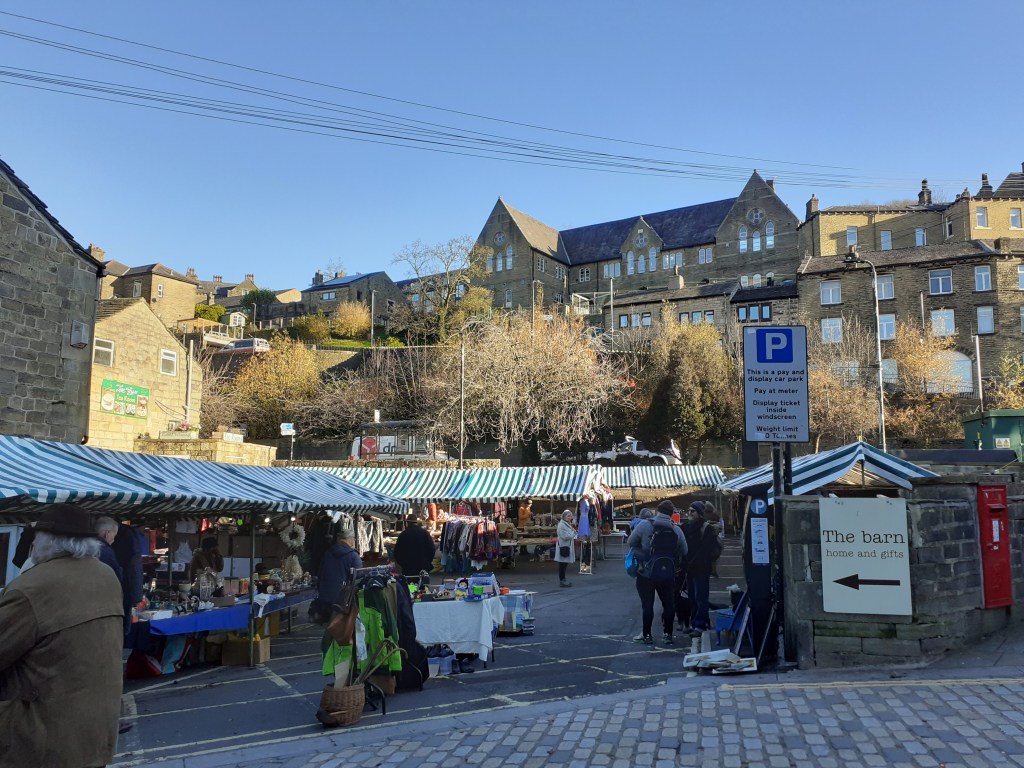
As I head down Market Street, past the Afghan rug shop and the magic crystal dispensary, I think about how the day might pan out. I am already feeling nervous. I’d forgotten what it felt like to hop on a train to somewhere you’ve never been and start knocking on doors. It’s been a long time since I’ve done this, what if people aren’t as sociable?
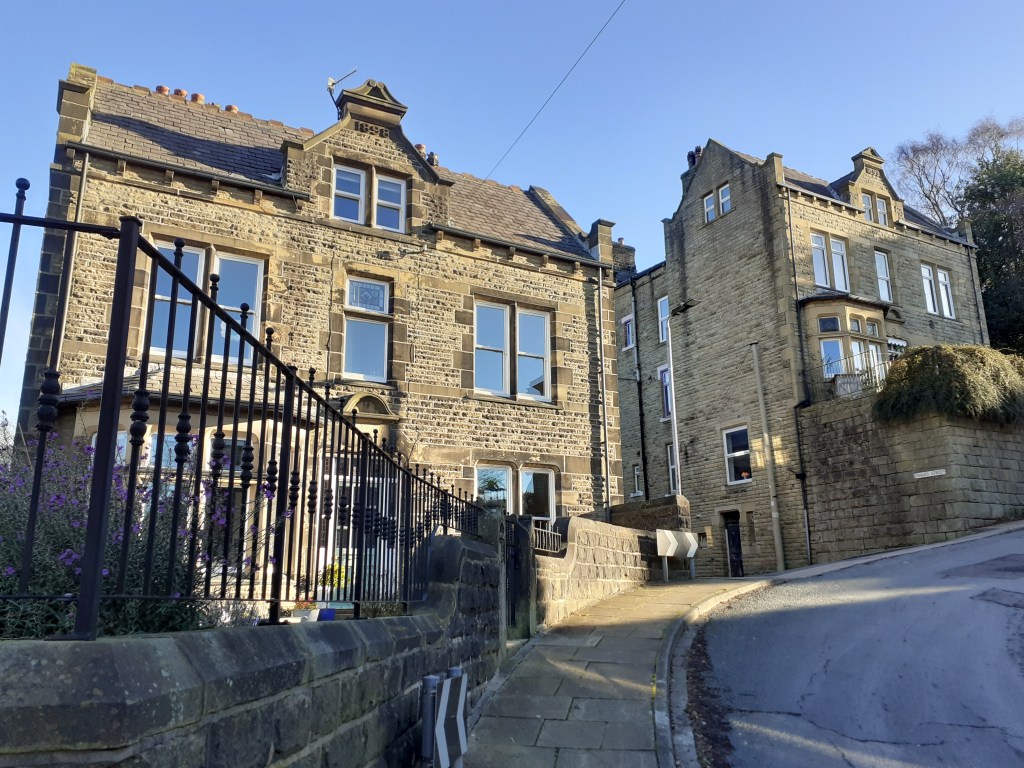
I get to Birchcliffe Road and begin my ascent. The Dodnaze estate is at the top of this incredibly steep hill. I start climbing, passing a huge Victorian school surrounded by regal looking town houses. It is a clear sunny day and the views of the market below are fantastic. Halfway up, I pass a group of 4 walkers in lycra, catching their breath on a cobbled wall.
‘Can’t talk, breathing,’ one of them pants to the other.
‘We’re nearly halfway,’ another replies.
‘I think halfway is an overstatement.’
I too am wheezing by the time I approach the top. I crawl up a concrete staircase and reach the edge of Dodnaze.

It feels strange coming from the town centre, with its austere looking buildings, to suddenly being confronted with terraces that look a lot more familiar. I am filled with the old familiar feeling of adrenaline, mixed with the niggling worry that I am somehow doing something illegal. I sense strangers peering at me from behind net curtains.
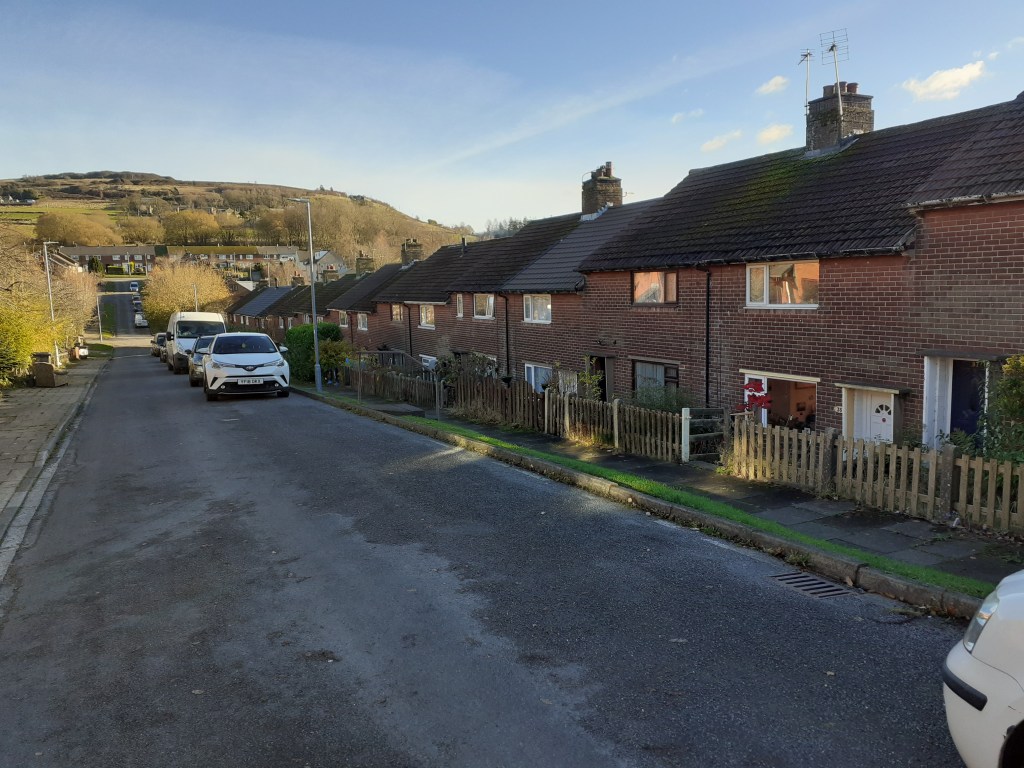
I reach Hirst Grove. On the right-hand side is a line of 1960s red brick terraces. They have neat front gardens with hedges and rose bushes. A few have children’s scooters and mini trampolines.
The street is very long and the road is very wide. It is open and exposed. I take a minute to look at the houses stretching off up an incline. Behind distant roofs, the buildings abruptly end and are replaced by the imposing hilltops of the surrounding valley.
This seems like a logical spot. I would normally start at number 1, but I can’t find it, and I’m already concerned about how long I might have to stand outside. I decide that now is not the time to hang about.
OK then. Here we go.
Intense nerves as I open a black metal gate. I head down two concrete steps and knock on a blue wooden door, wondering exactly why I’ve chosen to do something this ridiculous all over again. As I count the seconds in my head, my heart beats at double speed.
An older woman comes to the window in pink pyjamas. She looks at me bewildered. It’s quite difficult to explain something like this through glass.
‘Do you have a minute to come to the door?’ I ask. ‘I don’t want any money or anything’.
She shakes her head slowly. I back out of the gate.
That’s OK. That’s fine. It’s important to remember that not everyone will say yes. Persistence is key here.

I carry on along the street. A woman with short brown hair comes out in a body warmer.
‘Hi there, my name’s Rowan, I don’t want any money or anything. I’ve come from Newcastle and I’m doing an art project, have you got a minute and 10 seconds to spare and I can explain what it’s all about?’
‘No, sorry love,’ she answers in broad Yorkshire. ‘I wouldn’t want to waste your time.’
That’s fine. Again, it’s early days. I’m sure with enough effort, I will find someone who is interested. I keep going.
A man in a parka and a woolly hat answers and tells me he’s not feeling very well. A woman comes to the door with a phone up to her ear and tells me she’s in the middle of work. A man who looks a bit like Frank Zappa answers and seems initially really interested, until I tell him it’s an art project, at which point he abruptly informs me that he has to go.

It’s been 45 minutes. I am starting to get a little worried. Maybe it’s because the BBC are involved. I am imagining what it’s going to be like to go back to the producers and tell them it just hasn’t worked. That it worked in the 12 locations I tried before this, but not today. I seem to be stumbling over my words a lot. I’m struggling to speak with any degree of confidence. What if I’ve… forgotten how to be a Door-to-Door Poet?
No, that’s ridiculous. I just need to keep trying.
I carry on. More nos. No after no after no. A woman tells me she’s waiting for a taxi. A man tells me he’s about to have some lunch.
At the next door along, a gentleman in a flat cap and a grey jumper comes out. I ask him if he has a minute. He says yes! I do my introductory poem.* He is smiling.
Thank Christ for that, it’s all going to be OK.
‘You know what,’ he says, once I’ve finished. ‘This is something I’d normally be really interested in, but I’m actually right in the middle of something.’
NOOOOOOOOOO.
We make vague plans for me to return later, but I think we both know it’s not really going to work.
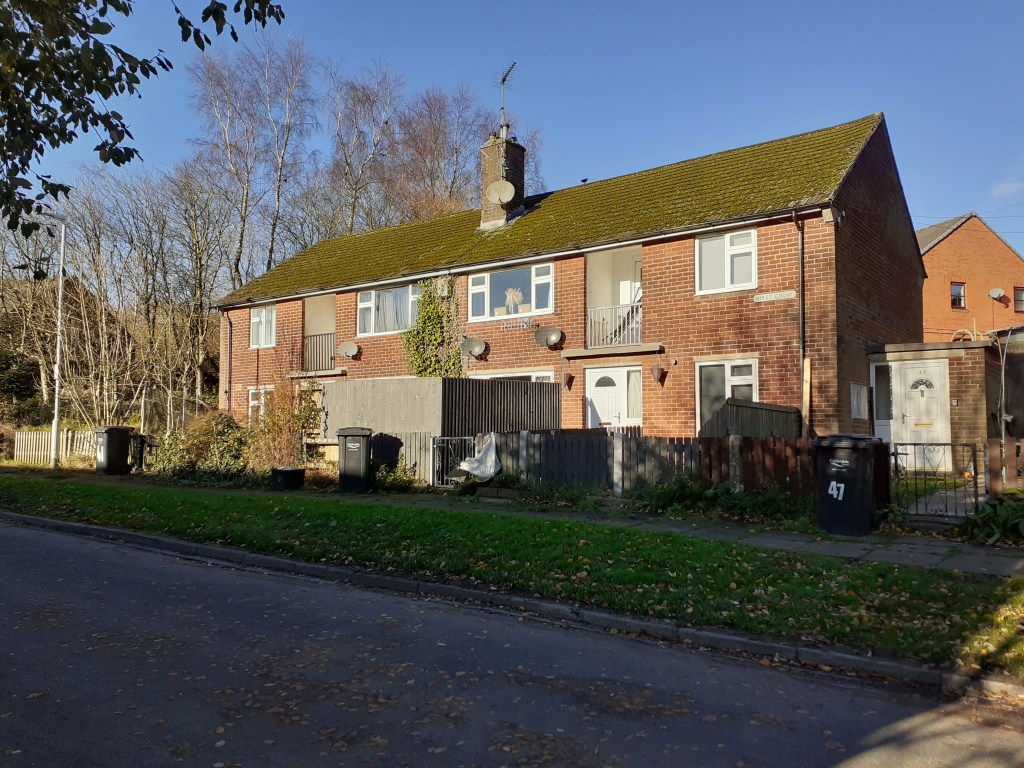
I have reached the end of the right-hand side of the road. It has been an hour. The cold has already seeped through my many layers and I am beginning to panic. Maybe people are just a bit suspicious of artists here? There’s already quite a lot of them in Hebden Bridge. I decide I’ll try for one more hour before I accept defeat and skulk off back to the town.
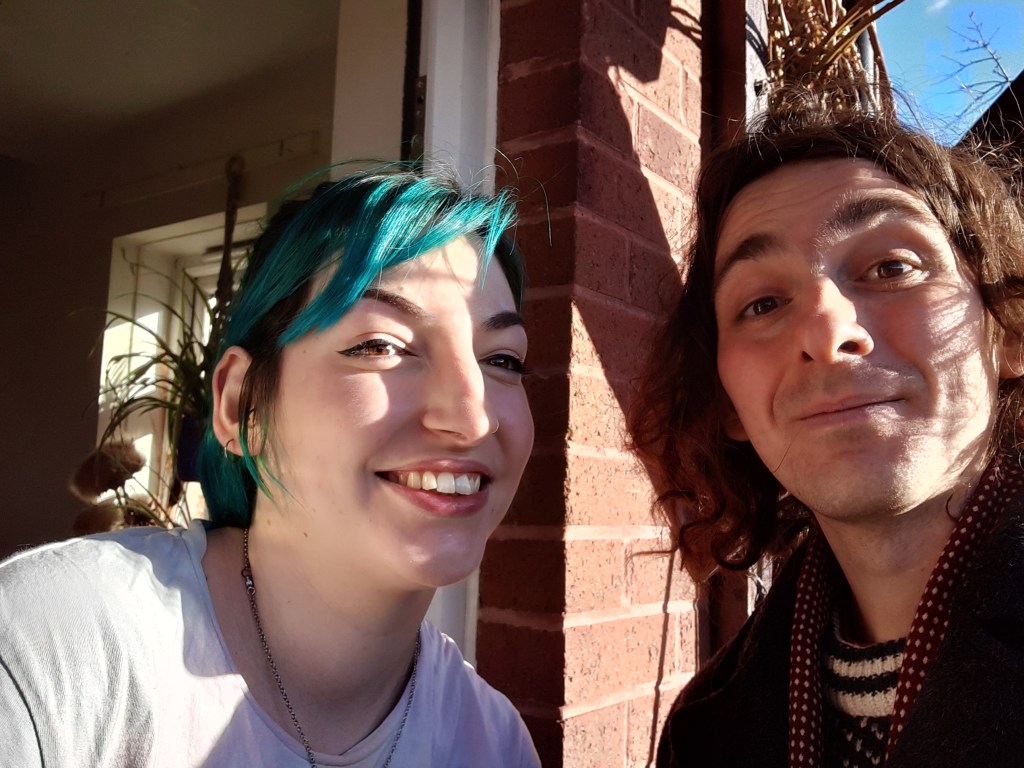
I cross the road and head towards some newer looking semi-detached houses. At the second door, a woman in her mid-twenties’ answers with blue hair and cool tattoos. I ask if she has a minute. She says yes! I start doing the poem. She listens attentively. She is laughing.
‘So I’m in the neighbourhood collecting ideas for poems, and I was wondering if you’d be up for getting involved?’
‘Yeah definitely,’ she says.
YES!! She said yes! This is it. I am back in business!!
The woman tells me her name is Molly. She actually lives in Leeds and is here visiting her mother, but she grew up in Hebden Bridge before she left to start her degree. I ask her what’s important to her.
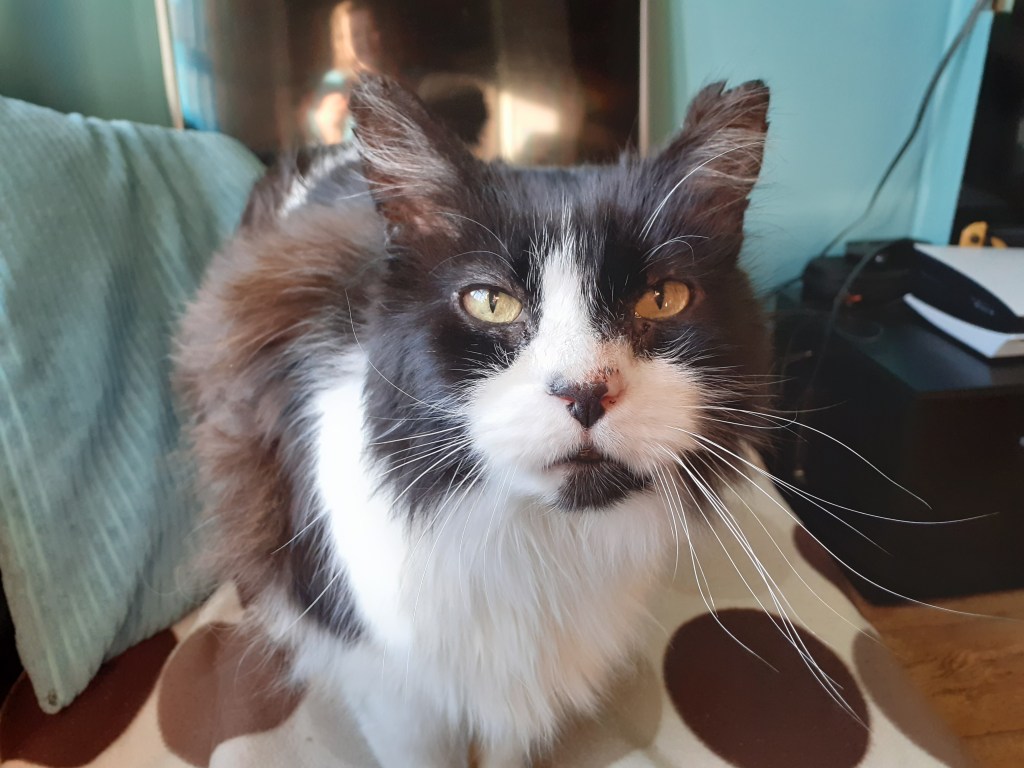
‘The first thing that comes to mind is pets,’ Molly says. She tells me she got a cat from the RSPCA during the pandemic.
‘He was my first ever pet. We became lockdown buddies,’ she smiles.
It’s a subject I can relate to, having done the same thing at around the same time. Molly tells me she got Milo when he was 13 years old, which I find interesting. I remember the feeling of looking through the different animals in the shelter. The idea of taking in an older cat felt like a bit of a risk, having as I did no real experience looking after animals. I was worried they might have a health problem, that I wouldn’t know what to do. I tell her it sounds like a brave thing to take on.
‘As soon as I saw him, I knew I had to take him in. He’d got an infection and had to have all of his teeth removed. I couldn’t stand the thought of him spending the rest of his life in there. When I got him, the staff told me he would never be a lap cat, he would never want to be stroked. Within 4 days, he was getting under my duvet. He’s the most aggressively affectionate cat.’
It feels like this says a lot about Molly’s character. And it makes me think about the assumptions we make about animals too, about the expectations we place on them. I offer to write Molly a poem along these lines. She says she’s up for it!
I am so happy. It feels like things are really turning around. I make plans to deliver the poem and head on my way. As I start to leave, Molly points at a big, fluffy, black and white cat walking past on the road. His ears are tattered from territorial fights. He is covered in little bits of grass and those sticky seeds that cling to fur.
‘You see him there,’ Molly says. ‘He’s the boss of this neighbourhood.’
I ask the cat if he wants a poem. He walks away immediately.
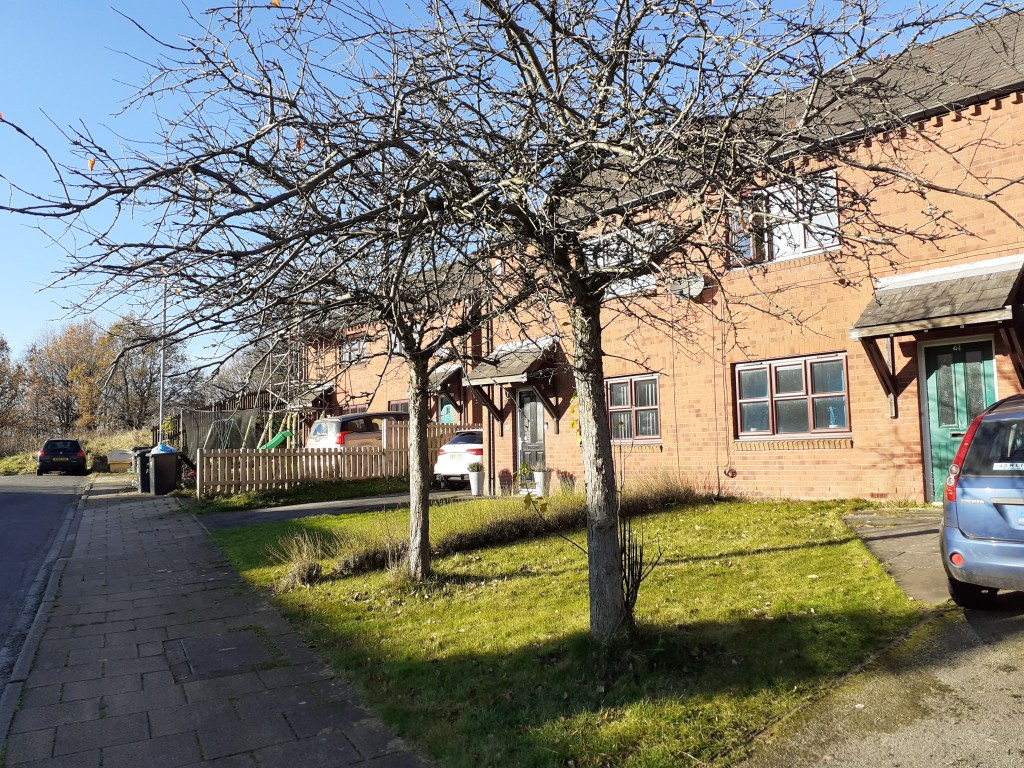
My success rate after this is pretty much the exact opposite of everything that has happened so far. At the next door along, a woman answers in a turquoise hoodie and politely listens to the poem. I ask her if she wants to get involved.
‘Do you want me to write a poem for you?’ she asks nervously.
‘No, I would write the poem for you,’ I explain.
‘Oh right,’ she says, visibly relaxing. ‘In that case, do you want to come in?’
This is Kate. I head in to her house and take a left into the living room. I sit down on one of the sofas, adorned with jazzy throws. At this point, the bruiser cat from down the street comes through the back flap. I tell Kate I’ve already heard all about him.
‘He’s famous,’ she says, casually. ‘The trouble is, he thinks he owns the place.’
‘So when I say what’s important to you,’ I explain. ‘It can be anything at all.’
‘Well, I think this country has gone to the dogs,’ Kate tells me. ‘I think the people who run it are very elite. I think Brexit was a terrible idea. I’ve always voted Labour. When they were in last time, they did make a difference. I had a disabled child and, before 1997, the syringes we used to treat him were always old and broken. They were supposed to be single use. But as soon as Labour got in, we were given syringes for every use, like you should be.’
I am saddened to find out at this point that Kate’s son died 8 years ago. I tell her I’m sorry, that I don’t want to pry too much into what must be a painful subject. But it feels like she is OK with this being part of the story.
‘He was born with a condition called trisomy 10p+, it’s a chromosome disorder. He lived till he was 15. He was given a 3 month life expectancy, so he did much better than they thought he would. He was non-verbal, he was tube fed, but he was happy. He communicated in his own way.’
We talk about the time Kate spent in hospital with him over the years, about the pressures on the NHS more recently.
‘The NHS is on its knees,’ Kate says. ‘It’s been underfunded for years. The work loads are impossible.’
I suggest that a lot of staff seem to be leaving due to the perilous conditions.
‘Of course,’ she says. ‘You have somebody’s life in your hands. Even though it won’t be their fault, the staff feel like they’ve let the patients down. And then they leave. Why wouldn’t you?’
It’s a heart-wrenching subject and a reminder that you never quite know what you’re going to find behind any door. I make plans to deliver Kate’s poem, then get ready to leave.
‘You’re the first Door-to-Door Poet I’ve ever met,’ she says, as I step out into the street. I tell her I still think I’m the first.

This is now unfolding much quicker than I ever imagined. I’ve found 2 out of the 3 people I am looking for. I reflect on how swiftly my fortunes have changed and how confidently I am now knocking on every door. Am I more relaxed because people are stopping to talk? Or are people stopping to talk because I’m more relaxed? Either way, the finish line seems tantalizingly close.
There’s only a few doors left on the street. I don’t really expect anyone to say yes here, having already had two yeses in as many houses. But I tap on the next letterbox anyway and a woman in her 30s comes out in an ankle-length puffer jacket. There is a little girl stood next to her in a Minnie Mouse outfit. When she says has a minute, I’m kind of taken aback. When she immediately says she’s up for getting involved, I can’t believe my luck.
This is Nicole. I ask her what’s important.
‘I’d have to say family,’ she replies. ‘I’ve got two daughters, they’re 5 and 2.’
Nicole explains that she’s lived in Dodnaze her whole life. She grew up just a little further down the street and her parents both grew up here too. She’s keen to talk about what a nice place it is.
‘When people hear the word “council estate”, they get a certain idea. But it’s such a lovely area to live in. Everybody gets on. And you’ve got beautiful countryside right on your doorstep.’
I’m interested in Nicole’s thoughts about the town centre, on what it’s like to live next to it.
‘I don’t really go into town very much to be honest,’ she tells me. ‘I might pop in to buy some milk or some essentials. Other than that, I just don’t really go. On a Saturday afternoon, you can’t move for people. It’s a bit much.’
I ask her if the price of things has any effect on this.
‘I would say it does. I mean, cafes are a good example. I want to support local businesses. But a coffee is a treat for me. If I am going to treat myself to something like that, I don’t want to be paying over the odds. I tend to go to the Costa machine in the supermarket.’
It’s a thorny issue. As you know, I don’t know much about Hebden Bridge. In the area I live in, there are people who might be quite judgmental of a statement like that. But it strikes me that this is so often the elephant in the room. It is easy to talk about supporting local businesses. But if the prices are designed for people on a different pay scale, it can force you to use the alternatives.
What I like about Nicole is that she’s very diplomatic. She isn’t pointing fingers.
‘It’s a tourist town,’ she explains. ‘You’re always going to get that with tourist towns. But one thing I would say is that me and the family went to York recently for a day trip. Food and drinks were actually much cheaper than they are here.’
It feels like an important point to end on. I thank Nicole for getting involved before hitting the road.
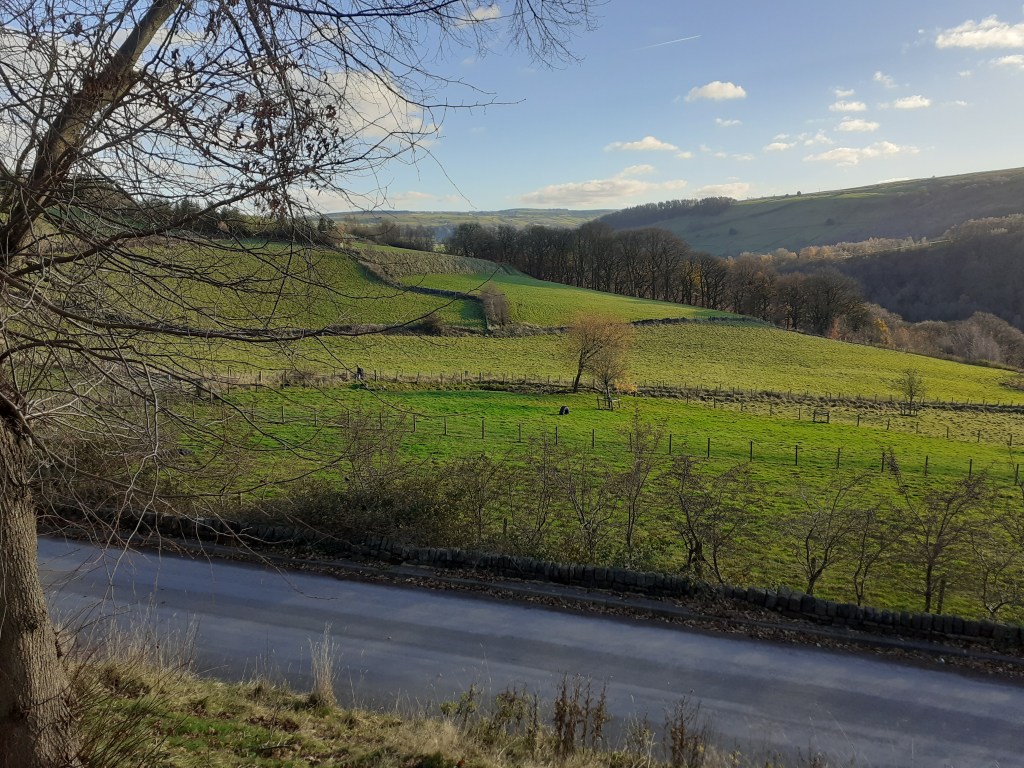
Standing on the edge of the estate, I look out across the fields. I take a minute to consider how things have gone today. It was a shaky start, but I’m so pleased I came to Dodnaze. It’s reminded me what I love about being a Door-to-Door Poet. The people I spoke to have made such passionate points about animal welfare, about cuts to public services, and about the cost of living.
Furthermore, I am for the umpteenth time taken aback by how welcoming and open the participants have been; by how enthusiastic they have been about poetry, despite my worries that they wouldn’t be.
As I gaze out at the sun-dappled hills, I think about what Nicole said. It seems wrong that she doesn’t feel able to visit the town centre as much as she might do. I suppose it doesn’t come as a suprise. But if there is one small positive in all this, it’s that I also get the feeling that the people of Dodnaze are happy getting on with their own thing. There is a sense that the residents are enjoying the peace, that they’re not really too concerned about what happens down in the hustle and bustle of the town.
Perched here, in this picturesque valley, I can certainly relate. At the very least, I find myself feeling grateful that there is still a small space where the rent is more reasonable, where people who aren’t highly-paid can still inhabit this beautiful part of the world.
And with that, I head off on a mission to climb the biggest hill I can find.
A selection of the finished poems will be broadcast on BBC Radio 3 on 22nd December 2023, 10pm. Search for The Verb in the BBC Sounds App.
* INTRODUCTORY POEM
I’m a Door-to-Door Poet
and I know that sounds quite crazy,
but this could be worse though,
I could be the Avon lady.
In school they taught me poetry’s bust,
wrote by toffs who’ve turned to dust
on country manors, deathly shrouds,
serious lords and fluffy clouds.
I found it quite hard to relate,
I grew up on a rough estate-
walls thin as paper used to trace,
the clouds an endless tone of grey.
I’m here to make poetry exciting,
like bungee jumping, but less frightening,
and I’m standing here to find
the subjects that flow through your mind.
Tell me about your life.
OK, maybe not the whole of it.
I’ll stick it in a poem
or at least have a decent go at it.
Maybe you heard a great story
you’d love to see in rhyme.
Maybe your blood is boiling
from a recent council fine.
Maybe you dropped your smart phone
and it fell down the toilet,
I don’t know, I can’t decide for you
cos that would spoil it.
So cheers for listening to these verses,
I hope I got across my purpose,
don’t slam the door, don’t be nervous,
the Door-to-Door Poet is at your service.
 Door-to-Door Poetry
Great post Rowan, enjoyed it very much. I am looking forward to hearing the finished poems. Cheers Jeff
LikeLike
I found this really interesting as a new resident in Hebden Bridge! I live off the big hill you walked up (although not as high as Dodd Naze) and was really surprised to find a non-terraced, normal looking area at the top of the hill. Having come from London I’ve not really considered the high prices in town because they’re still a bit cheaper than what I’m used to, and I work remotely so I’m relatively insulated from commuting and other costs (though not on a London wage, it’s higher than the area average). This article has really made me think differently about the divides in town – looking forward to hearing the poems!
LikeLike